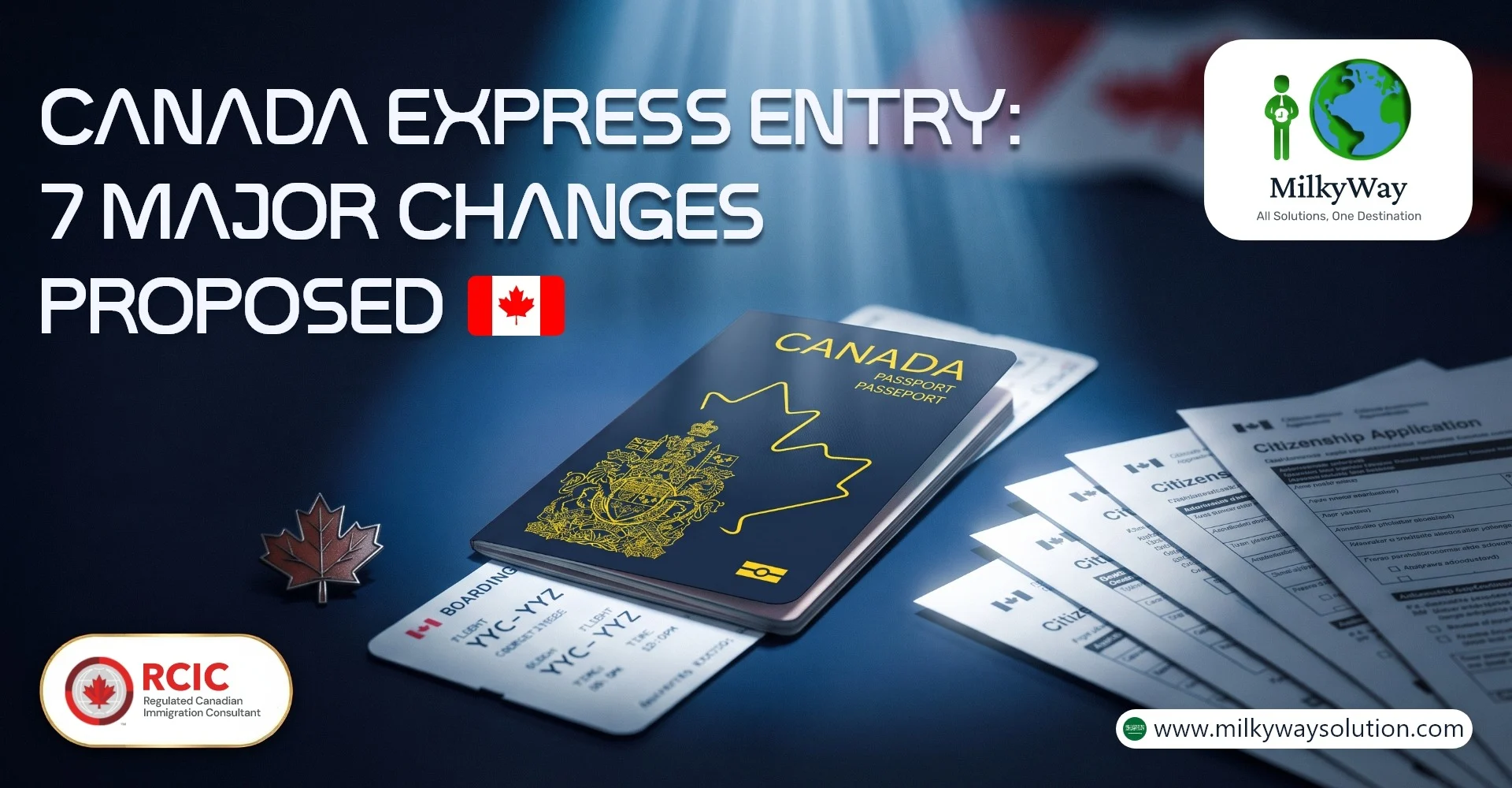
Canada’s Express Entry system may see important changes as Immigration, Refugees and Citizenship Canada (IRCC) reviews how skilled immigrants are selected for permanent residence. The proposed reforms aim to simplify the system, reduce duplication, and focus more strongly on factors linked to economic success.
These changes are proposals, not final rules. Candidates should continue following the current Express Entry requirements until IRCC officially announces any updates.
1. Three Express Entry Programs May Become One
Currently, Express Entry manages three federal economic immigration programs:
- Federal Skilled Worker Program
- Canadian Experience Class
- Federal Skilled Trades Program
IRCC is considering replacing these three programs with a single Federal High Skilled program. The goal is to create one set of eligibility requirements and make the application process easier to understand.
This could reduce confusion for applicants who currently need to determine which program best matches their profile.
2. A Minimum High School Education Requirement
Under the proposal, candidates may need at least a Canadian high school diploma or an equivalent qualification to enter the Express Entry pool.
Foreign education would generally need to be verified through an Educational Credential Assessment (ECA), where applicable.
At present, education requirements differ between the three Express Entry programs. The proposed change would create a more consistent education standard across the system.
3. New Language Requirement of CLB 6
IRCC is considering a common language requirement of Canadian Language Benchmark (CLB) 6 in English or the equivalent NCLC level in French.
This would apply across all four language abilities:
- Reading
- Writing
- Listening
- Speaking
Currently, language requirements vary depending on the Express Entry program and the candidate’s occupation. A common CLB 6 requirement could make eligibility more consistent, although some candidates may still need higher language scores to remain competitive in the CRS ranking system.
4. One Year of Cumulative Skilled Work Experience
Another proposed change concerns work experience.
IRCC is considering requiring one year of cumulative skilled work experience in a TEER 0, 1, 2, or 3 occupation during the previous three years. The experience may be gained in Canada or abroad.
The word “cumulative” is important. It could allow candidates to combine qualifying periods of work rather than relying only on one continuous period of employment.
This proposal may provide more flexibility for applicants with different employment histories, including skilled workers who have gained experience outside Canada.
5. Changes to the Comprehensive Ranking System
The Comprehensive Ranking System (CRS) is used to rank candidates in the Express Entry pool. IRCC is considering changes to the factors used to calculate CRS scores.
The proposed review focuses on factors that may better predict economic outcomes in Canada, such as:
- Language proficiency
- Employment and earnings
- Canadian work experience
- Education
- Age
- Job offers in selected occupations
Some existing CRS factors may be reduced, changed, or removed. These include points connected to siblings in Canada, Canadian education, French-language ability, and other personal factors.
However, the final scoring structure has not been confirmed.
6. More CRS Points for High-Wage Occupations
One of the most significant proposals is the introduction of a High-Wage Occupation factor.
Under this proposal, candidates with Canadian work experience or job offers in high-wage occupations could receive additional CRS points. The system may consider occupations where the median wage is higher than the national median wage.
The proposal is intended to recognize candidates whose employment and earnings may indicate stronger economic outcomes.
IRCC is also considering reintroducing job offer points, but with a focus on qualifying high-wage occupations rather than all job offers.
7. Changes to Existing Eligibility Factors
IRCC is also reviewing some requirements connected to the current programs.
Possible changes include:
- Removing the Federal Skilled Worker Program’s 67-point selection grid
- Removing the Federal Skilled Trades Program’s job offer or certificate of qualification requirement
- Creating common eligibility rules for all candidates
- Reducing overlap between program requirements and CRS factors
These changes could make the system more streamlined, but they may also affect how candidates prepare their profiles and assess eligibility.
What These Proposed Changes Mean for Applicants
The proposed reforms show that Canada may place greater importance on language ability, skilled employment, earnings, and labour-market needs.
Applicants should continue to:
- Improve their English or French language scores
- Maintain accurate employment records
- Check whether their occupation falls under an eligible TEER category
- Prepare education documents and ECAs where required
- Review their CRS score regularly
- Follow official IRCC announcements
Candidates should not make major immigration decisions based only on proposed reforms. The final rules, implementation dates, and transitional arrangements will depend on future announcements from the Canadian government.
Final Thoughts
Canada’s proposed Express Entry reforms could change how skilled workers qualify and compete for permanent residence. The possible introduction of one federal skilled program, a common language requirement, cumulative work experience, and high-wage occupation points may significantly affect future applicants.
However, the proposals are still subject to government review and may change before implementation. For the latest updates, applicants should rely on official IRCC information and seek professional guidance based on their individual circumstances.
Planning to apply for Canada Express Entry? MilkyWay Immigration can help you understand your eligibility, review your profile, and prepare for the next steps in your Canadian immigration journey.